Enough of this crashing satellite stuff for a while. Here is a cheerful and fun video. This is the full theme song from the daily International Year of Astronomy podcast theme.
Saturday, February 14, 2009


Friday, February 13, 2009
Satellite crash - the news just keeps getting worse.
At first we just think "Oops! That was an unfortunate and expensive incident." Now as more details come out about the satellite collision, we find that the situation just gets more serious and could affect many more spacecraft. First, the remaining Iridium satellites are all in the same orbital altitude as the accident victims, so there are parts flying through that orbit which will eventually spread like a cloud of dust. This will put the Iridium system in danger since parts could eventually impact and destroy or damage the other satellites. This creates a chain reaction, on more gets hit, parts fly off, hits another, more parts fly....
It's a lot worse than just ducking under a flock of geese in an Airbus A320!
So the latest bad news is that the Hubble cold be in danger, as well as the astronauts going on the final upgrade mission. Here is a quote from ABC News website:
It's a lot worse than just ducking under a flock of geese in an Airbus A320!
So the latest bad news is that the Hubble cold be in danger, as well as the astronauts going on
 the final upgrade mission. Here is a quote from ABC News website:
The already hobbled Hubble Space Telescope could be further harmed by space debris from Wednesday's unprecedented satellite collision, a chief NASA scientist told ABC News. There has always been a small risk that Hubble and other spacecraft could be damaged by the thousands of pieces of junk floating through space. But now that the space telescope is orbiting 75 miles below where the collision took place, experts say the risk is much greater. "Clearly debris from the event is going through the altitude that the Hubble flies, so we're going to be looking at what is the new risk to Hubble," said Nicholas Johnson, chief scientist at the Orbital Debris Office at NASA's Johnson Space Center.
Thursday, February 12, 2009
What are the chances?
 Just a tiny fraction of a second difference, a couple feet or a tiny thruster nudge and the Iridium could have avoided the speeding Russian satellite carcass. Almost like standing on the sidewalk waiting to cross the street when flock of seagulls fly over you. Yeah, that happened to me yesterday and I was watching them in case I had to step to the side to avoid getting splattered.
Anyway, this picture shows the paths of the international incident between the US and Russian spacecraft. You know what they always say about crossing railroad tracks trying to beat a train through an intersection. Whack!
UPDATE: More information just keeps showing up about this. I just came across a video simulation of the collision. If this was cloud from a volcanic eruption (Google Alaska's Mt Redoubt) we would be getting some pretty sunsets! The chunks are most likely too small to be seen from the ground though, but who knows?
Wednesday, February 11, 2009
Crunch....two satellites collide in orbit.
I just got an email from one of my news sources at Spaceflightnow.com about a couple satellites that collided. Or I guess I should say...a US Iridium satellite and a hunk of leftover Russian junk.

A commercial Iridium communications satellite collided with a Russian satellite or satellite fragment, Tuesday, creating a cloud of wreckage in low-Earth orbit, officials said Wednesday. The international space station is not threatened by the debris, they said, but it's not yet clear whether it poses a risk to any other satellites in similar orbits.

A commercial Iridium communications satellite collided with a Russian satellite or satellite fragment, Tuesday, creating a cloud of wreckage in low-Earth orbit, officials said Wednesday. The international space station is not threatened by the debris, they said, but it's not yet clear whether it poses a risk to any other satellites in similar orbits.
| Read more here |
Tuesday, February 10, 2009
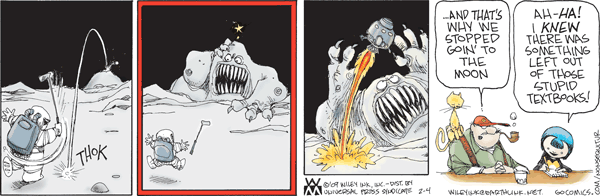
Monday, February 9, 2009
Saturn ring gaps named
It used to just have a few names like "Cassini Division" or "Encke gap". But the USGS has officially given more names to gaps in Saturn's rings. Bond, Dawes, Herschel, Russell, Jeffreys, Kuiper, Laplace, Bessel, and Barnard are now names for gaps between the rings in Cassini division and the C-Ring. I didn't know the USGS tracked that stuff, but they do more than just earthquakes here on Earth.
....and we once thought the Cassini Division was a big gap that a spacecraft could fly through.
....and we once thought the Cassini Division was a big gap that a spacecraft could fly through.

Saturday, February 7, 2009
Fallen satellite finally flies.
Five years ago while being prepared for launch, the NOAA-N satellite had an unfortunate incident while being tipped from vertical to horizontal to be worked on. Seems that something wasn't attached and the satellite fell over onto the floor.
After $217 million worth of repairs, the bird finally flew this week. When officially operational, it then becomes known as NOAA-19. This is the last of the series of weather satellites which first started flying with TIROS 1 back in 1960. There have been 43 launched and this one is the 16th and final of the current series.
The fun thing about these satell ites is that anyone can get images from this with fairly modest home equipment. A modified police scanner, a simple antenna, and a computer with software you can often find for free (see Wxtoimg) or for a reasonable fee you can add more features if you register the software. I've just received my first image on my home station this afternoon, and the picture is very clear and sharp (click on the image for a full sized view).

After $217 million worth of repairs, the bird finally flew this week. When officially operational, it then becomes known as NOAA-19. This is the last of the series of weather satellites which first started flying with TIROS 1 back in 1960. There have been 43 launched and this one is the 16th and final of the current series.
The fun thing about these satell
 ites is that anyone can get images from this with fairly modest home equipment. A modified police scanner, a simple antenna, and a computer with software you can often find for free (see Wxtoimg) or for a reasonable fee you can add more features if you register the software. I've just received my first image on my home station this afternoon, and the picture is very clear and sharp (click on the image for a full sized view).
Thursday, February 5, 2009
Mars Bolide splatter on the surface.
The Mars Reconnaissance Orbiter's HiRISE camera has once again found something pretty cool. This time it's a fresh set of craters on the surface which were created by a bolide which made it all the way to the ground. Here on Earth, we occasionally see these big, sky illuminating, and often exploding meteors. But most of the time, they break up well before hitting the ground - creating a valuable item which would go for big bucks on Ebay if you were more greedy for money than a piece of space stuff!
Since Mars' atmosphere is a lot thinner than Earth's stuff makes it to the ground much more often. That is what happened in this photo. This crater formed sometime between 2003 and 2007 since Mars Odyssey had imaged this area before and there was no splatter marks. This object had probably exploded in the air, broke up into smaller pieces and slammed into the surface creating the dark marks around the craters. But between the two big ones, there is a straight line. It's thought that the two pieces hit the ground at the same time, causing an interaction between the dust clouds or shock waves interacting with each other - forming the line between them. Is that cool or what?!

 most of the time, they break up well before hitting the ground - creating a valuable item which would go for big bucks on Ebay if you were more greedy for money than a piece of space stuff!
Since Mars' atmosphere is a lot thinner than Earth's stuff makes it to the ground much more often. That is what happened in this photo. This crater formed sometime between 2003 and 2007 since Mars Odyssey had imaged this area before and there was no splatter marks. This object had probably exploded in the air, broke up into smaller pieces and slammed into the surface creating the dark marks around the craters. But between the two big ones, there is a straight line. It's thought that the two pieces hit the ground at the same time, causing an interaction between the dust clouds or shock waves interacting with each other - forming the line between them. Is that cool or what?!

Tuesday, February 3, 2009
Update on station damage - none!
Seems that the station didn't do a "Galloping Gertie" oscillation after all and damage itself.
NASA update:
NASA update:
The ISS Mission Management Team determined Tuesday that the station was not structurally damaged by the oscillations that were experienced during a Jan. 14 reboost. A reboost that had been scheduled Wednesday will not be performed while Russian flight controllers review procedures and techniques.On-orbit Status:Undocking of the ISS Progress 31 cargo craft is scheduled for Thursday, and the launch and docking of Progress 32 remains on track for next week. Future reboosts will be timed with other planned activities to maximize rendezvous options for the various spacecraft scheduled to visit the station.
ISS Reboost Update: The IMMT (ISS Mission Management Team) agreed this morning to a Russian proposal to postpone the reboosts that were planned for tomorrow (2/4) and Saturday (2/7). Additional reboost may not be necessary if the Soyuz launch is delayed by one day (landing would be delayed by 2 days & Soyuz docked operations increased by 1 day). May need a reboost in the March timeframe. In the meantime, SM jets (not ME engines) will be used in the case of a DAM (Debris Avoidance Maneuver) if necessary.
Rocking and rolling ISS during boost.
Every now and then the ISS needs to be given a little push to stay in the proper orbit. If the station never got a boost now and then, it would simply fall out of the sky like Skylab and the Mir station did. A planned rocket firing was canceled today since there are worries that the station may have been damaged by a rough boosting last month. The automated boost is normally very gentle,  when rockets are fired on the Zvezda module. Astronauts could normally sleep through a boost. Basically, last month the booster rockets started to gimbal back and forth searching for the right angle, and set up a swaying in the station that reached the ISS's resonant frequency. Then the entire station started oscillating. Remember what happened to the old Tacoma Narrows bridge?
This problem will possibly delay visiting spacecraft this month and a Soyuz flight in March. The video below shows the rocking while the rocket was burning.
 when rockets are fired on the Zvezda module. Astronauts could normally sleep through a boost. Basically, last month the booster rockets started to gimbal back and forth searching for the right angle, and set up a swaying in the station that reached the ISS's resonant frequency. Then the entire station started oscillating. Remember what happened to the old Tacoma Narrows bridge?
This problem will possibly delay visiting spacecraft this month and a Soyuz flight in March. The video below shows the rocking while the rocket was burning.
Monday, February 2, 2009
Update on my new magazine subscription
I mentioned a couple days ago that I ordered a subscription to Astronomy Technology Today magazine. I paid an extra $30 on top of the yearly $15 so I could have access to the back issues on-line to download as .pdf files. Well, I get home tonight and find a big box at my door. Huh? I don't remember orderin g anything?
I open the box and find that they sent me ALL the back issues from the magazine. Way cool! I don't remember telling them that my attention span for reading stuff on the screen is about as short as a clear night in Seattle, so this a greatly appreciated bonus. Now where do I start in this big pile......
g anything?I open the box and find that they sent me ALL the back issues from the magazine. Way cool! I don't remember telling them that my attention span for reading stuff on the screen is about as short as a clear night in Seattle, so this a greatly appreciated bonus. Now where do I start in this big pile......
New Google 5.0 - 3D Mars / Earth oceans
Amazing. Google just released the version 5.0 of Google Earth and it has everything. It now includes the ocean floor of Earth so you can dive down to the Titanic wreck or go down the bottom of Mariana Trench if you like. There is also a feature where you can see how cities and other f eatures have changed over time, not sure if I want to see what happened to the Seattle area, probably kind of depressing seeing how everything is covered with "progress".
Mars is also improved now with 3D textures, canyons, mountains and landing sites. I guess you could say this is also the bottom of the Martian ocean if the discovery of past water is correct. Very impressive piece of software!
Works in Windows, Mac, and Linux.
 eatures have changed over time, not sure if I want to see what happened to the Seattle area, probably kind of depressing seeing how everything is covered with "progress".
Mars is also improved now with 3D textures, canyons, mountains and landing sites. I guess you could say this is also the bottom of the Martian ocean if the discovery of past water is correct. Very impressive piece of software!
Works in Windows, Mac, and Linux.
| Google Earth |
Subscribe to:
Posts (Atom)