Monday, April 13, 2009

"Star Vistas" new astronomy photo book.

I was going nuts at work today, and had to get outside for some air. I did one of my favorite "get some air" walks and went over to Barnes & Noble to look around a bit. I came across a book called "Star Vistas" that looked great. The book is by Noel Carboni and Greg Parker. I'm familiar with Noel since I bought is Photoshop Astro Tools plugin a while back and use it all the time for processing my images.
Forewards written by Sir Arthur C Clarke, Sir Patrick Moore and Dr. Brian May. You gotta admit that Dr. Brian May is quite an amazing guy, he was the guitar player for Queen for 30 years then finally went back and finished his doctorate in Astrophysics.
The book looked so good that I went back and found a copy for $30 after shipping from an on-line dealer ($39 at the store - I'm cheap, I avoid tax and save what I can online!)
Look for a review later once I get the book and have a chance to read through it.

Disasters, accidents and incidents...

I came across this chart on one of my favorite space geek sites - CollectSpace.com - which was pretty fascinating and a bit scary too. The chart shows all the major space disasters resulting in crew deaths, injuries, aborts and a lot of other things that were probably not known about.
The gray boxes are Russian, white are United States, yellow is very bad since that resulted in the loss of the entire crew, gray stripes is some kind of bad thermal issue...and so on (there is a key to the colors on the chart).
Some interesting ones - Soyuz 18-1 had an abort during a second stage problem, Apollo 11 nearly got stuck on the moon with a broken circuit breaker (I read about this once and Buzz stuck a pen cap in the breaker to allow the engine to light), and look at all the stuff dropped on EVAs during shuttle missions!
Click on the chart to download and view it. Pretty interesting, and frightening. Hopefully, this won't be updated with more yellow.

(Click to view full chart 2.5 meg .jpg)

Thursday, April 9, 2009

The mysterious "Rubber Rooms" under complex 39 launch pads.

Back in the Apollo days of the mighty Saturn V launches, a special room was built under the launch complex 39 pads. They called this the "rubber room", no it wasn't built to subdue or hide crazy astronauts from the public, but was actually a kind of bomb shelter. If the Saturn blew up, it would have gone off like a small atomic bomb (see my earlier post).
The plan was, if the rocket misbehaved before firing the engines, astronauts would quickly exit the spacecraft, run across the arm, take a speedy elevator down the tower, and dive down a hole to slide into the depths of the launch pad. Once they stop sliding they would get up and dive into a vault type room built on rubber pads. They strap into some seats and let the Saturn above blow itself into tiny bits. They could stay down in the hole for 24 hours while rescuers dug them out of the rubble.
Today, if the shuttle blows up on the pad (assuming there is time to run), the crew slides down baskets, dives into a bunker, then they get into tanks and drive quickly away.
These rooms are still under the pad, but locked shut. I guess they aren't forgotten, but still one of the less known trivia items about the space program.


Tuesday, April 7, 2009

Ultimate Lego space shuttle.

When I was a kid, I used to pull out my huge box of Lego (I still have it, and it's about 50 lbs now) and spend a rainy afternoon on the floor of my room building an airport. I was pretty sloppy with colors and just put together buildings, planes, and terminals so they looked like a failed Rubik's cube attempt. This was real Lego too, not that stuff with all the special parts that they have nowadays, we had to use our imaginations. Not a single Jar Jar Binks in my box - and still none. Lego purist all the way!
Anyway, here is a Space Shuttle made by a couple of Japanese master Lego builders who spent 1,590 man hours and about 65,000 Lego bricks to build this. Pretty darn awesome! I wonder how they had the time to build this? No jobs? Or was this their job? Hopefully, they picked up the spare parts on the carpet, we know how much that hurts to step on in the middle of the night with bare feet....
(Thanks to Phil Plait's blog for the info on this)

Yes....more Redoubt.

Ok, I like volcanoes. Got a problem with that?
Big Picture had a cool photo essay today with some photos from Alaska....

More volcanic stuff seen from above.

I'm on an RSS feed from NASA's Earth Observatory Site which has new images of the Earth from space every day. There is always some volcano blowing up someplace leaving a mess around it.
There is a section of images from Mt. Redoubt that are pretty amazing. They are taken from directly above the volcano with fancier stuff than I have access to.
I think this is one of my favorites so far (right).
Just look at that big, black, nasty cloud of ash headed directly toward Homer.
Here is the results of the volcano downstream from the mountain. The oil terminal looks like it took a pretty good hit from the lahar. This is the reason that if you live in Orting, Enumclaw, maybe the lower parts of Puyallup or even the Kent valley, you better be aware that you are living on top of an old lahar from Rainier!
Renton Highlands might not be the fanciest place to live, but I'm on a hill, out of the lahar zone - and I have a great view of he volcano if/when it explodes. Grab the camera, lawn chair and binoculars and head up the street to the school field!

Sunday, April 5, 2009

Redoubt eruption Saturday seen from space - in Renton, WA basement.

After watching for a while, I finally found that I captured some images of one of Mt. Redoubt's eruptions from my basement station. Yesterday, (Saturday 4/4/09 5:55 ADT) the volcano blew off a nice big ash cloud to 50,000 feet. The NOAA-17 satellite made a pass (click right photo) over the area about 4 hours later where you can see that the mountain was still busy spewing. The next image (left photo) was about 7 hours later NOAA-18 passed, Redoubt had calmed down, but the big ash cloud can be still seen extending to the south.
Homer, Alaska was right in the path of the plume and for a while it totally blocked out daylight while the ash fell on the snow. Probably familiar if you rememberber St. Helens and Eastern Washington back in 1980.
The skies were sunny over Seattle for a change, with high hazy stuff, but we'll take it over the snow we have had this week! Also, look closely at the ocean near San Francisco, airplane contrails can be seen over the water.
The NOAA satellites that are active are NOAA 15,16,17,18, and 19. I don't get anything from NOAA-16 since it's APT transmitter screwed up shortly after the satellite went active, and NOAA-19 was just launched a few months ago and will be the last of this series of spacecraft. The satellites are in a polar orbit where they orbit over the poles and cover the whole Earth. If the satellite is above the horizon, I can pick it up and it will send down images of what it is directly flying over at the time at about 500 miles above the Earth. The signals can easily be heard on a Radio Shack police scanner (or similar) around 137 Mhz.

Thursday, April 2, 2009

Brian Bat Foundation

Yeah....more stuff on Brian the Space Bat.

Tuesday, March 31, 2009

STS-119 has ended, but Brian the space-bat lives on.

The other day I was looking for more silly things on Brian, the space bat and his incredible, but short, journey. I can across a great site at www.space-bat.com. It looks like another blog site, but there are some great graphics, drawings, and a few t-shirts to commemorate the flight of space bat.
I think I need a t-shirt, nobody but a very few people would understand the humor of it!
The never before published official crew photo

If a rock falls on Mars and there is nobody there to hear it, does it make a noise?

I hope nobody minds that I often find blog topics from other blogs, that come from someone else's blog! I found this neat thing on Universe Today, but then it was tied in with Cumbrian Sky which is Stuart Atkinson's blog.
So I guess as long as I pass credit I should be following proper blogger ettiquite?
Anyway, I would assume tht a rolling boulder on Mars would make some kind of sound. There was a microphone on the Phoenix lander, but I thing time ran out before it could take a listen to the sound of Martian winds blowing. I read somewhere that sound would travel in the thin atmosphere, but would have a different tone to it. I won't say more since I'm not sure and foreget the details of that. I'll have to Google that.
Stuart is one of those clever guys that takes raw data from the Mars orbiter and uses the data to create really amazing images. He had this rolling rock on his site today. The image shows that Mars does have movement an things happen. Not just a dead rock with dust blowing around.
Bounce, bounce, bounce.....

Sunday, March 29, 2009

A very brief peek at the ISS.....and the curse continues

Finally, we had a day today that almost looked like spring, but still a little cool. I spent a few hours out in the observatory cleaning up unused cables, vacuuming the carpet (yes, we do have a carpet in there), and even spent about an hour cleaning up the corrector plate on the scope. The corrector had a couple years worth of pollen, dead bugs, and other gunk stuck on it.
The moon was out as a thin crescent and was a tempting target, and a good focusing object for the upcoming ISS pass at 8:20. It was going to be a perfect photo pass at about 60 degrees up, and slightly to the south. I was excited about the promising skies and finally a chance to get some good images of the station with the new panels completed.
I played with the moon a while then looked up, uh oh....no, no, NO, not again!! Maybe I should just start assuming this will always happen? Yes, clouds moving in at just the time of the ISS pass. I wasn't going to waste it, so I tried anyway. Got a couple little peeks through some holes, but that was all. It should have been a full pass, clear skies, and possibly a whole bunch of good images. Nope.
15 minutes later after cussing,swearing, and shaking fist at the sky, and restraining mysef from kicking the computer (I updated Windows and my imaging software refused to run now - thanks again Microsoft), skies cleared again.
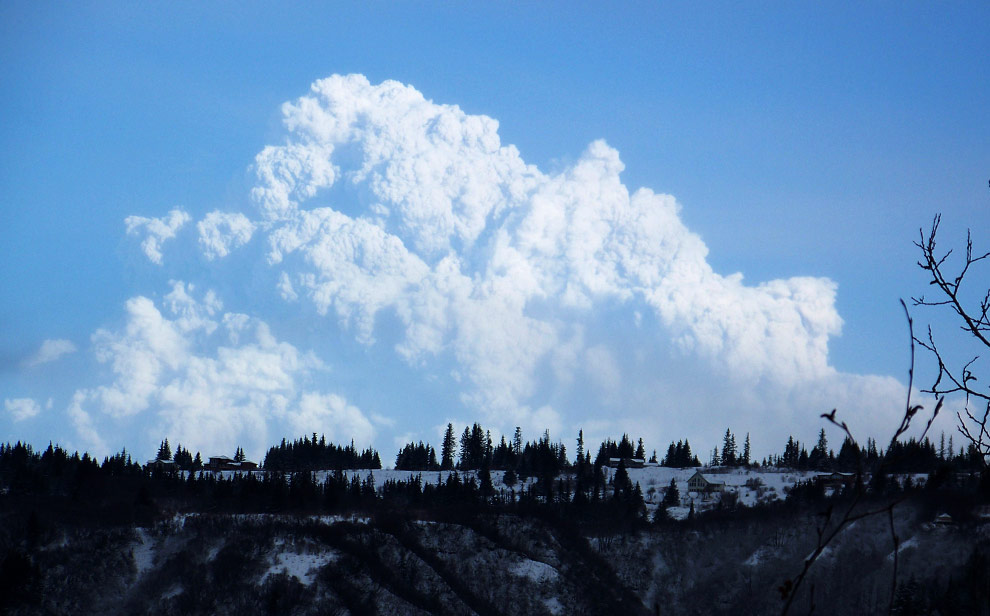
Ok, I did get one somewhat decent image but I forgot to remove the 6.3 focal reducer since I was using it on the moon, so it should have been a little bigger. The cloud photo is an actual photo taken after the pass to share my pain.
I got one fairly good shot, so I should stop complaining. No forget it, I have a good reason to complain. Grrr!
(click for full size image)

Saturday, March 28, 2009

Details of a near shuttle disaster released.

Details were released yesterday of a very close call with Atlantis during the STS-27 mission with 5 time shuttle astronaut Hoot Gibson. This was a secret military flight, so not much has been said about it until now. It was also only the second flight after the Challenger disaster in 1986.
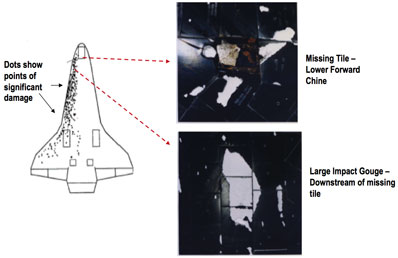
During launch, a chunk of debris came off the top of the right booster and bounced all the way down the right wing of the shuttle damaging about 700 tiles including blasting away tiles down to the bare aluminum. Astronauts looked at the damage with the camera using the robot arm. Seeing how bad it was, Hoot Gibson pretty much figured "we are all dead". During reentry, Gibson monitored control surfaces for any indication of failure of the wing and figured if he saw some deflection, he had about 60 seconds left to live and would use that time to tell mission control how he really felt about their diagnosis of he problem. Ground engineers basically blew it off and said "things will be fine, don't worry about it". (See the white spots on the shuttle wing in the photo)
Mike Mullane wrote a chapter in his book "Riding Rockets" which was quite scary to read. Read the book if you haven't it's one of my favorites up there with Mike Collins' "Carrying the Fire" - which is probably the finest books written by an astronaut.