Saturday, August 8, 2009

Animated Jupiter impact site.

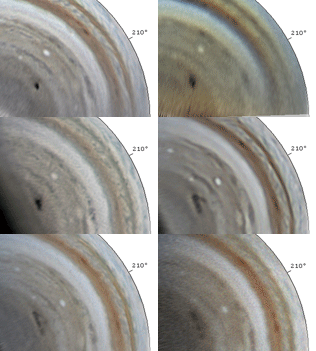
Spaceweather.com has a great animated image on the site today showing the spreading of the Jupiter impact cloud. This was discovered several weeks ago by Anthony Wesley in Australia and has become known as the "Wesley impact site". Lucky guy!
German astronomer Hans Joerg Mettig has converted some of the best images into polar projections showing the movement and dispersion of the cloud. I'm not sure if these are the "best" of all the photos out or Wesley's excellent shots. Whatever they are, they make an impressive little animation.

Thursday, August 6, 2009

Another very fine Lego shuttle.

Lego expert Ben Watson has created a really nice shuttle model out of Lego. Not sure how many parts he used, but sure is pretty!


Another meteorite on Mars?

Opportunity is on it's long path to the big crater about 12 miles away, but was stopped again by an interesting rock seen in it's path. Looks like another meteorite has been found just sitting on the ground like a discarded bottle. The arm will extend and take a sniff of the rock using the alpha particle X-ray spectrometer to get composition measurements to confirm it's a meteorite.
This is probably fairly common on Mars since the big chunks would get through the thinner atmosphere and hit the ground more than it would here on Earth. Not even a discarded toolbag would make it safely down!
(click photo on right for red/green 3d)

Discovery on the pad....but late.

Easy to see why the shuttle was late getting to the pad. STS-128 is due to launch on August 25. The famous cargo this time will be the "Colbert" treadmill!

Tuesday, August 4, 2009

How about one more Earth view?

Another pretty interesting view of Earth from way out was released today. This time it's from the Indian spacecraft "Chandrayaan-1" which is currently in orbit around the moon. The image is blurry since the spacecraft's cameras are set to focus on the surface - about 60 miles below. That's like a nearsighted person trying to look at something far away, in this case approximately 250,000 miles away.

First view from GOES-14 - full Earth.

GOES-14 was launched into geosynchronous orbit on June 27. One month later on July 27, the first image is down from 22,240 miles out. The image was taken last Monday at 11am Seattle time - just when we were about to start out record breaking heat wave here in Seattle. You can clearly see us down there, surrounded by the Cascade volcanoes (white spots), and the long trails out in the Pacific ocean are actually contrails left by ships way out there.
Click on the image to see a very large image of the Earth. Lots of detail in the image down to .62 mile resolution.
| NASA info |

Sunday, August 2, 2009

Weekend sky objects.

Clear skies this weekend despite warm temperatures from the aftermath of our all time 103 (105 here at my house!) record temperature in Seattle. NEVER been this hot in recorded history. Basically, it sucked.
Nice and warm out for playing out late though, can't sleep in the heat very well anyway. Here are the latest images.
Jupiter - this is the 'boring' side of the planet right now, sure the Great Red Spot is a good viewing destination, but these days the imact site of the asteroid on the other side of the planet is the favorite target. This image is probaby one of my best of Jupiter.
M27 Dumbbell nebula. An easy target since it's fairly bright. Skies were lousy with a lot of smog from the stagnent air this week, and the moon was still up. Worked out well though. I didn't use a focal reducer on this on in hopes that my guiding was improved. Pretty close, but still slightly elongated stars - I'm my own worst critic as usual!
The Ring nebula (M57). This turned out really nice. One of those rare times that my autoguiding just worked like it should with minimal cussing!

(Click on the images to view full size)

Wednesday, July 29, 2009

NGC 7008 or the "fetus" nebula

While waiting for Jupiter to get higher in the sky last night, I used that time to experiment with some imaging of a planetary nebula in Cygnus. There is a LOT of cool gassy stuff around that area to explore.
This one is 2,800 light years away, so this is one of the closer objects than some of my other targets. Still hard to image well though. I'm not totally happy with the focus on this since I think I had a little of the dreaded and familiar LX200 "mirror flop" when I went vertical. But then again, I am my own worst critic as usual. NGC 7008 is called the "Fetus Nebula". Maybe because it kind of looks like the Star Child from 2001:A Space Odyssey?
As always, click images for full size.

Tuesday, July 28, 2009

Jupiter hit seen from Renton backyard.

I got my chance last night to check out the view of the asteroid/comet (or spreading monoliths?) hit on Jupiter. Despite the 85+ degree temperature at midnight the skies were fairly stable and Jupiter wasn't looking too bad despite still being a little low in the sky. I took this image with the 12" Meade LX200 with a 2x barlow and the Vesta Pro webcam. It's a stack of a few hundred images, processed with Registax5, tweaked and fiddled with using The Gimp.
It's a little faint in my image, but the impact cloud can be seen in the shot. It seems that it will come around the planet and be centered in the view about 2 hours after the Great Red Spot passes.
I'm wondering how long this will be there before it dissipates?
(click the image to see an enlargement)

ISS across the sun.

Once again Thierry Legault has come up with another one of his stunning ISS/Shuttle images. This time it's the ISS with Endeavour parked at the station crossing the sun. The full solar array, shuttle wings and everything are visible against the sun. Way cool! Did I mention this is really totally cool? Yeah, very VERY nifty, awesome, cool!
Thierry is also one of the featured photographers in the new book that just came out this month by Robert Gendler - "Capturing the Stars: Astrophotography by the Masters."
I don' thave the book yet myself, but pawed through it at the bookstore. It's on my list of books that I must buy.

Monday, July 27, 2009

First peek from updated Hubble camera - Jupiter

I guess this chance was too good to go to waste, so testing on the Hubble camera was pushed aside to point the spacecraft at Jupiter. Unless you live in a cave, you probably know that Jupiter got smacked by a comet or an asteroid last week. This was discovered by an amateur astronomer (great job for us "little guys"!) in Australia. This chunk of stuff that hit Jupiter left a cloud of debris and smoke in the atmosphere that is easily seen in small scopes. (I'll give it a try this week from my backyard).
Scary thing is, if this was Earth, this could easily be an extinction type of thing for us. Good thing we have Jupiter out there sucking up stuff like a bit vacuum cleaner!

Tuesday, July 21, 2009

Google moon Apollo tour

Google takes one giant leap ahead of Microsoft "Bing" once again. Ok, it's not another search engine war, but a feature in Google Earth software (the moon part) that is pretty nicely done. The Apollo sites are all marked and you can zoom in on the landing sites and see a 3d LM siting there as well as other goodies. I'm sure before long, the actual NASA images will be there, they have "almost live" images added to Google Mars all the time, so I'm sure this will also be a new feature.
If you zoom down to the Apollo 11 site, there is an animated audio tour by Andrew Chaikin and Buzz Aldrin with an animated landing, photos, sounds and other stuff.
Another good Google thing to totally get lost in and later realize that several hours have been lost......so be careful if you peek at this at work!