Friday, November 20, 2009

If the Earth had rings like Saturn?

If the moon got too close, or a past moon broke up long ago so we had rings around the Earth, what would they look like?
I came across this interesting video that shows just that. I think from a lot of locations, this would block the southern sky along the ecliptic making it hard to view the planets or a lot of other good stuff to the south. Then again, the light pollution from this would be miserable too.
But then again, everything is so perfectly balanced to have life on this planet that if a moon broke up like that at one time, maybe we never would have evolved in the first place?


Of course we already have a ring around Earth that we made ourselves!

Sunday, November 15, 2009

Trying new processing tricks....

I went to the Advanced Imaging Conference in San Jose a couple weekends ago and learned some new processing tricks and ideas. I've been playing with my new skills on some of my old data to see if I can make improvements. Tony Hallas had some really great tricks that made a lot of sense and had everyone saying "oooh!" when he demonstrated them. I did buy his set of tutorial DVDs and they are great! But as expected, my stuff never looks like his. I just need to keep practicing.
Here are a couple of images that I've been playing with: (click the images to see full size)

M81 - I combined a few nights of images for some cleaner data this time. I brought out some more detail in the core dust lanes, didn't burn out the center (new trick!), and played with the colors a little. I think it looks better now.

M31 - My continuing quest of getting a decent shot of this that I can enlarge to a poster sized print. Sharpened up some of the dust lanes some more, brought out some more colors, but still fighting noise in the background. I'm slowly getting happier with this one.
Someday, I'll get some clear skies to test out my $360 worth of new filters. I bought a CLS filter, which should help with light pollution, and another H-Alpha filter (this goes into the camera body rather than screw on externally). I'll sell my old H-Alpha filter to justify the cost of this one. :-)

"Try SCE to Aux" - Apollo 12 + 40 years

Another 40th anniversary. This time it's the launch of Apollo 12, November 14, 1969. Pete Conrad, Dick Gordon, and Alan Bean were the 2nd flight to the moon after Apollo 11. Launching into a thunderstorm, the Saturn V was hit by lightning twice. "I got three fuel cell lights, an AC bus light, a fuel cell disconnect, AC bus overload 1 and 2, Main Bus A and B out!" was the call to Mission Control from Pete Conrad - who sat there with his hand on the abort handle.
The Saturn was still flying, so rather than yank the handle, they got a call from John Aaron, who had an idea "Try SCE to Aux" was his call. Alan Bean knew where that switch was, and flipped it to Aux. Telemetry was restored and Apollo 12 continued to the moon.

Saturday, November 14, 2009

Dangers of Astronomy

You would think that Astronomy would be a fairly safe hobby other than tripping over stuff in the dark, dropping expensive eyepieces, being frightened by sounds in the darkness, screwing up your back lifting a 12" LX200 onto a tripod...
This photo shows another potential danger of this hobby, depending on your focal length and aperture. (click for full size)(Credit to forum on CloudyNights for the photo - and Astromick blog where I saw this!)

Friday, November 13, 2009

Second and final Rosetta flyby of Earth.

The ESA spacecraft Rosetta, made it's second flyby of the Earth today. The spacecraft was launched back in March 2004, swung past Mars, back past Earth again in 2007, and then one more time today. They flybys close to the planets are for "steering" and boosting the spacecraft on course to Comet 67P/Churyumov-Gerasimenko (no, don't ask me how to say that either!) where it will deploy a lander to the surface in November 2014.
This is the timeline for the mission:
Launch 2 March 2004
1st Earth swingby 4 March 2005 (distance from Earth
: 1955 km)
Mars swingby 25 February 2007 (distance from Mars: 250 km)
2nd Earth swingby 13 November 2007 (distance from Earth: 5301 km)
Steins flyby 5 September 2008 (distance from Steins: 800 km)
3rd Earth swingby 13 November 2009 (distance from Earth: 2500 km)
Lutetia flyby 10 June 2010 (distance from Lutetia: 3000 km)
Comet rendezvous maneuvers 22 May 2014 (distance from comet: 600 000–100 000 km)
Lander delivery 10 November 2014 (distance fr
om comet: 1–2 km)
End of mission December 2015
The spacecraft whizzed past our planet at 29,820 mph missing by 1,541 miles.

Day before the flyby:
Close approach over Eastern US/Gulf of Mexico - Pick out the cities!

Looking back at home on the way out| Rosetta ESA site |
| Emily from Planetary Society's blog entry |

Water - and lots of it - confirmed on the moon.

Today one of the big stories on a lot of the news sites (CNN, and other non-science sites even!) was that NASA released results from the LCROSS impact last month. Water has been confirmed on the moon. "Indeed yes, we found water. We didn't find just a little bit we found a significant amount," said Tony Colaprete, principal investigator for LCROSS at a press conference.
When the booster hit the moon, it created a crater about 30 meters across. About 25 gallons of water was detected by instruments on the LCROSS spacecraft before it too hit the moon.
Pretty cool! May not have been much to see from Earth, but very successful and found what was being searched for.

Monday, November 9, 2009

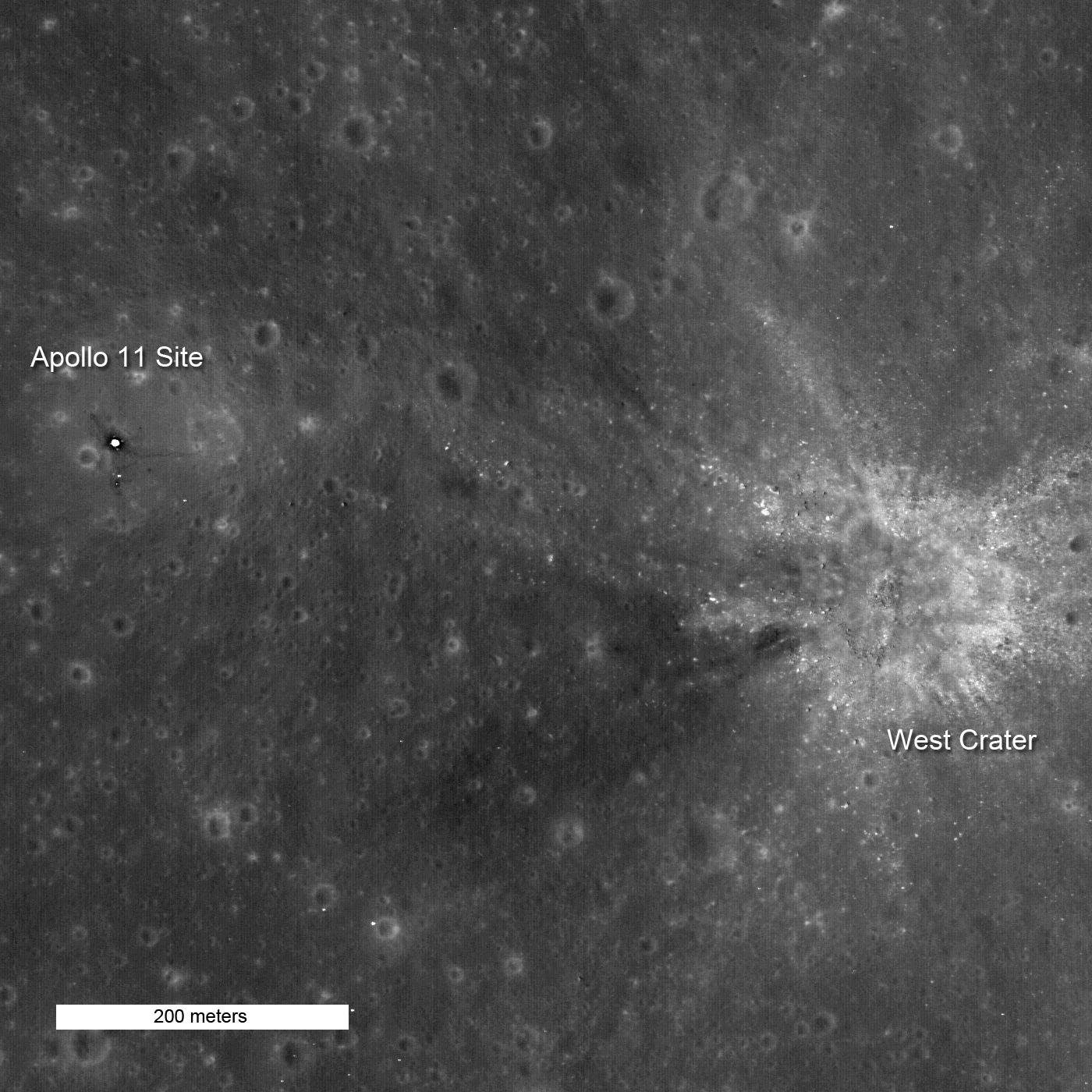
Another view of Tranquilty Base.

Once again, another view of one of the Apollo sites is released from the new lower altitude of the LRO. You can easily see the boulder field that Neil had to dodge when landing in this photo. Although, if it was your final landing in the LM, it would have been tempting for just a few more seconds of 'stick-time' to pad your logbook with! Yeah, we see he had his reasons for the overshoot.
Compared with the images recently released of some of the other sites, you can see that they really didn't walk far on this landing. They stayed very close just in case things got ulgy and they had to leave quickly.
I wonder how much other stuff will be imaged and identified?

Friday, November 6, 2009

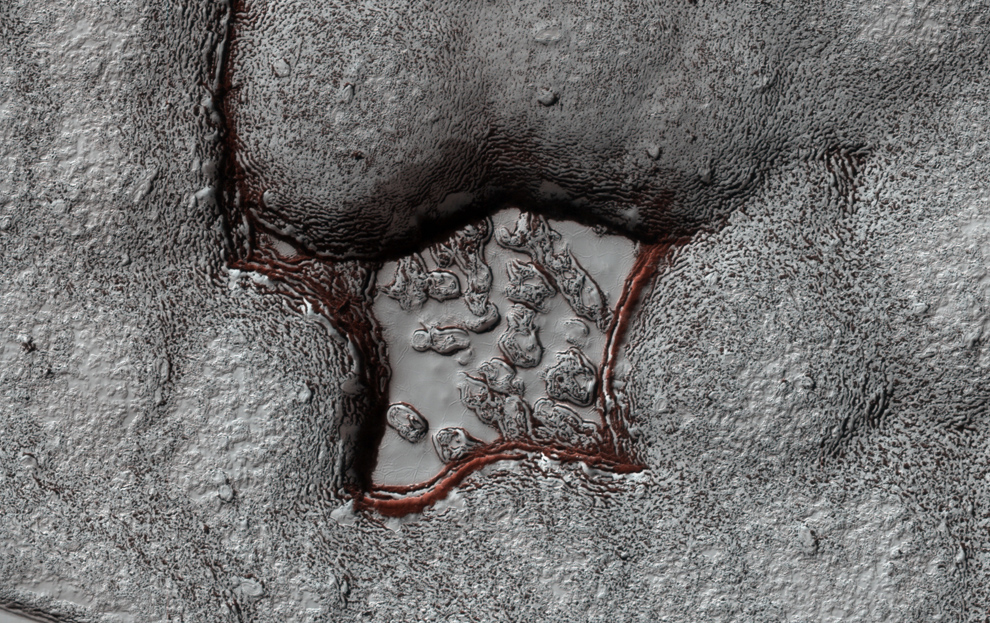
Microscopic disease - or Mars?

It looks like a close up view of the swine flu or some nasty disease you don't want to get from the seat of the public bus. Remember, flu season is ugly this year - wash your hands!
Ok, this is nothing contagious, just one of the latest images from Mars this week. The Big Picture has posted another impressive photo essay of Mars. I don't know much about modern art, but couldn't these be framed and hung in a fancy art museum?

Wednesday, November 4, 2009

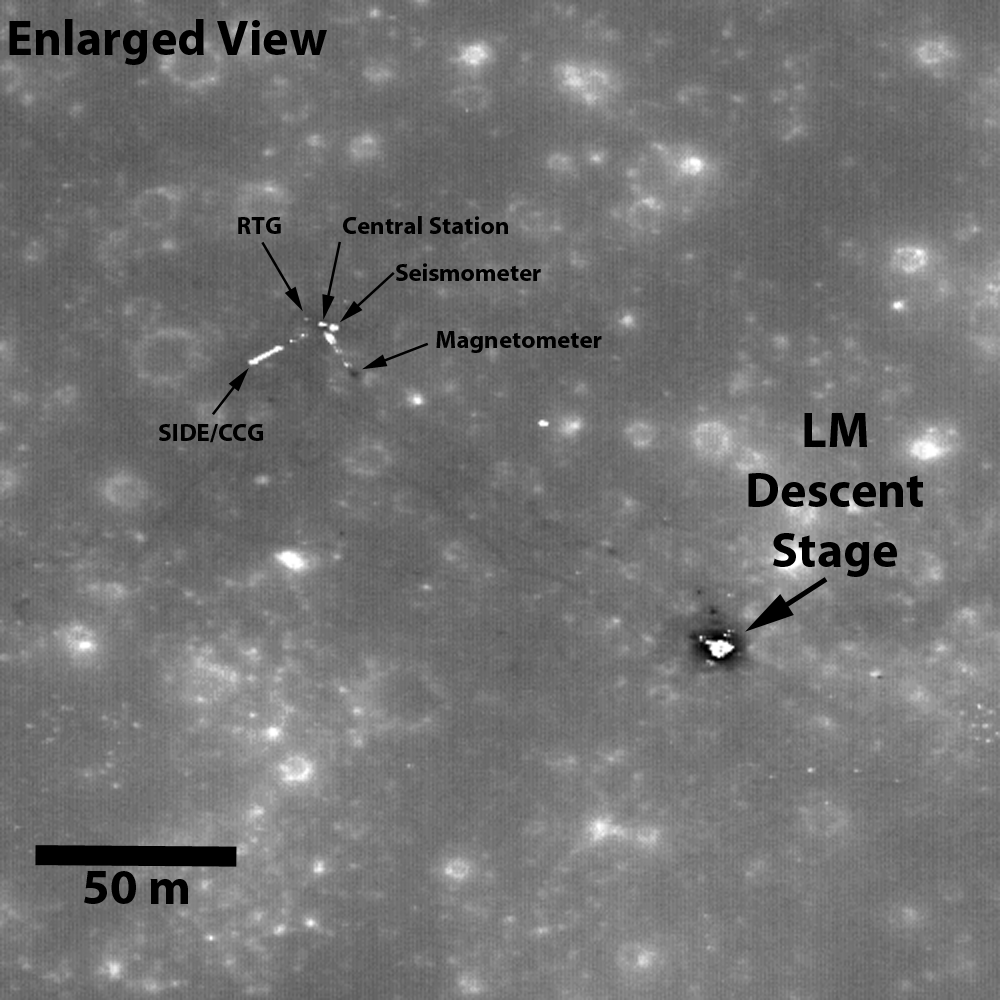
...and now more views of Apollo 12 site.

Just the other day, we saw the closeup view of the Apollo 17 site. Now here is another view of the Apollo 12 landing site. Complete with footprints, nice view of the descent stage clearly showing the 4 footpads, and gear left behind. Very cool!
Amazing to see these again almost 40 years later and realize that NOTHING has moved up there, and it's just the same as when they left. Of course I'm sure the flag has faded, and disintegrated in the sun, and the gold mylar on the spacecraft has probably turned into something else too. But remember, there is no wind, rain or other forces (well, maybe a bit of dust from a nearby meteor impact maybe) that will ever wipe away those footprints. They will always be there. Oooh spooky thoughts!
There is a lot more hardware up there that will probably be seen again. I'm kind of excited to see the Russian Lunokhod rovers. They should be fairly easy to spot, just like the Mars rovers, there is a lander, then follow the trail to the rover.

Tuesday, November 3, 2009

Last lunar footprints - seen again.

Apollo 17 was the last mission to the moon back in December 1972. Gene Cernan is still the last person to leave a footprint on the moon. Before leaving the surface, he said the following:
"As I take man's last step from the surface, back home for some time to come — but we believe not too long into the future — I'd like to just [say] what I believe history will record — that America's challenge of today has forged man's destiny of tomorrow. And, as we leave the Moon at Taurus-Littrow, we leave as we came and, God willing, as we shall return, with peace and hope for all mankind. Godspeed the crew of Apollo 17."
Finally, just before launch the final words on the moon were "Let's get this mother out of here"
So here we are 36 years later and nobody has walked on the moon since.
But....LRO is giving us the best views of the surface since Gene Cernan and Harrison Schmitt left.
Here it is, the Apollo 17 site including the flag and final footprints visible.

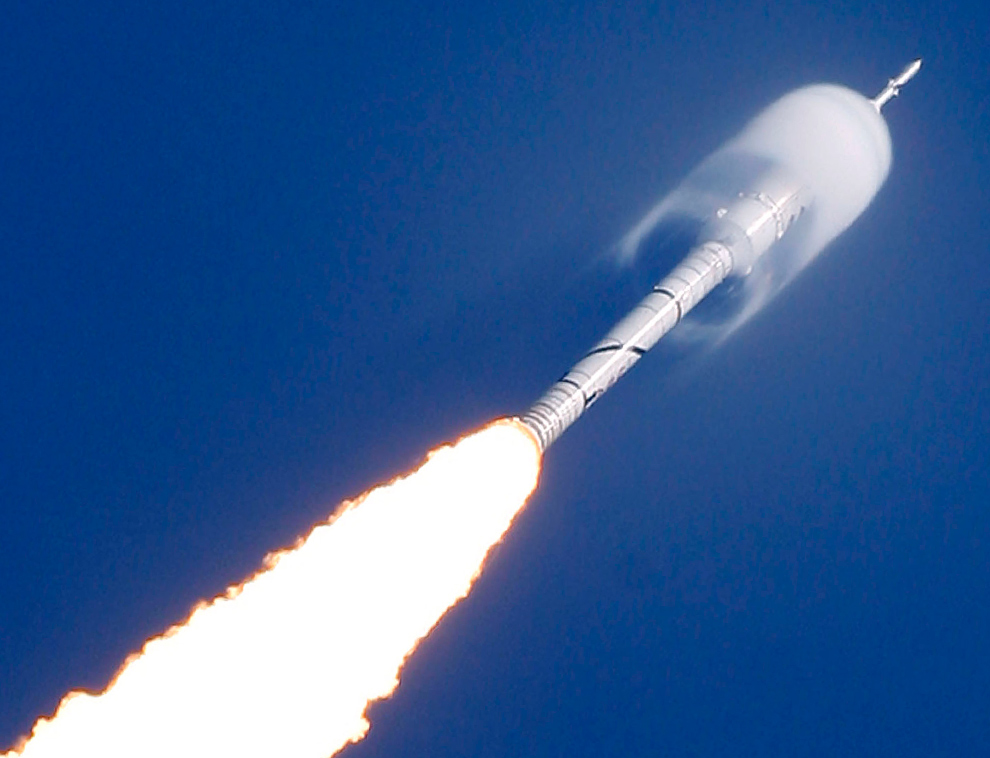
Ares 1-X photo essay.

Boston.com posted another one of those great photo essays. As expected, there are some angles and photos not seen before. Check them out at the link below.

Ares 1-X flight seen from 12,000 feet.

Here is a good video of the whole Ares 1-X flight from launch until splash. It was taken from a Cessna about 10 miles from the launch pad, at about 12,000 feet. Camera mounted outside the plane.
Easy to see the booster is the heavy part since the "dummy" payload just kind of floats around while the booster falls away. Look for the shockwave just before the chute comes out (at around 4:00) - then one of the chutes failed and it hit the water hard probably causing the dent in the booster that was found.